
Sources for Homer Glen Previous Residents
The best starting source depends on the period. Current parcel data supplies the PIN and assessed owner. The Recorder carries the title trail online for recent decades and in books or microfilm for earlier years. Regional directories and telephone books may identify past residents by address, while census pages show whole households only after their federal release period. Village-era permits can date changes to the site without proving occupancy.
| Source | Years it reaches | Where to use it | Evidence it provides |
|---|---|---|---|
| Will Recorder online index | Generally 1965 to current | Direct Search; paid Tapestry or Laredo | Recorded parties, dates, instrument, PIN, legal description, image status |
| Recorder archives | County series from 1836; plats to county inception | 158 N. Scott Street, office workstations, books, microfilm, copy request | Older deeds, indexes, plats, maps, and recorded instruments |
| Regional directories | Will County 1859 to 1860 and 1872 to 1873; Joliet from 1875 | Joliet Public Library Local History Room | Dated name and address lines with regional coverage limits |
| Telephone books | Joliet from 1908; Plainfield holdings 1924 to 1956 | Joliet and Plainfield library collections | Name, phone, address, and exchange clues |
| Federal census | Public schedules through 1950 | NARA and library genealogy databases | Household, relationship, age, and township context |
| Village records | Incorporation in 2001 forward, retention varies | Document Center, Building Department, Clerk, FOIA | Permits, inspections, plats, annexation, roads, and ordinances |
A source can overlap the target year without covering the exact street. Record gaps and geography limits should stay visible in the final timeline.
Reverse the Will County Deed Chain
Begin with the physical Homer Glen parcel, not with a surname. The assessor and GIS give the current PIN, situs, and parcel geography. Use those keys in the Recorder's Direct Search. On the current acquisition deed, the buyer is the grantee and the seller is the grantor. The seller may be the prior owner. Search that seller as a grantee to locate the earlier purchase, then repeat the pattern.
- Save the current address, PIN, assessed owner, subdivision, and legal-description clues from assessment and GIS records.
- Find the current purchase instrument and note its document number, date, grantor, grantee, legal description, and prior reference.
- Search the grantor as an earlier grantee. Test spelling variants, trusts, organizations, joint names, and the percent wildcard when needed.
- Repeat backward by deed, comparing PIN, lot, block, and legal description at each transfer.
- At the online cutoff, move to the Recorder's books, archive workstations, microfilm, plats, or a detailed copy request.
- Grantor
- The party transferring an interest in the recorded instrument.
- Grantee
- The party receiving the interest shown in that instrument.
- Chain of title
- The linked sequence of recorded transfers for the same land.
- Legal description
- The land description that remains a stronger bridge than a changeable street label.
The Recorder's historical-search page shows the online and archive routes available for Homer Glen house history.
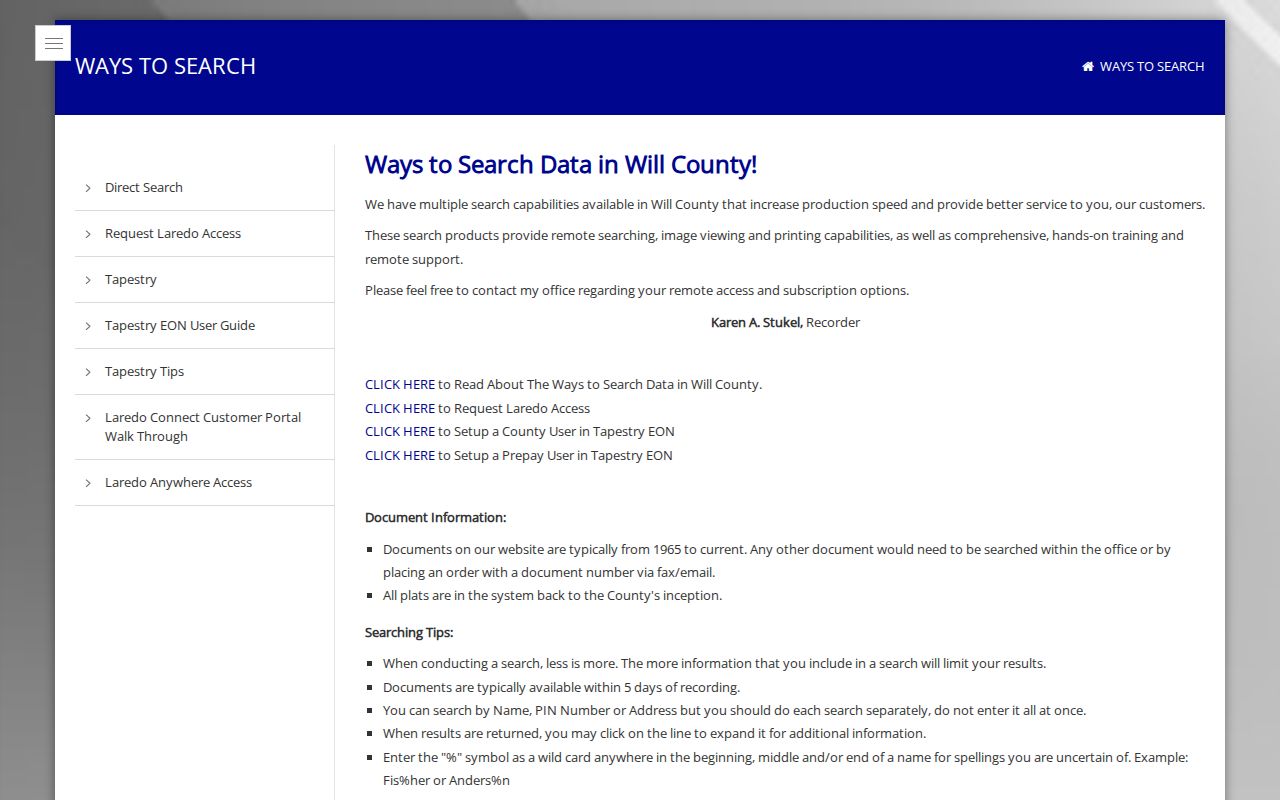
Use it to choose the correct index, then keep a separate note of any image or copy that still must be ordered.
Homer Glen Records Before 1965
A web search that stops at the Recorder's general 1965 cutoff does not end the trail. Will County land records begin with county organization in 1836, and plats are described as reaching county inception. The public archives room holds workstations, historical books, maps, plats, and microfilm. A request can be made with an exact document number or enough names, trust, date, instrument type, address, and PIN detail to identify the item. Staff can help start the search but do not perform a complex title examination.
The Recorder archives and copy service lists office and remote routes. Archive copy prices in the research include $1 for a letter-size page, $2 for 11-by-17, $4 for a 24-by-36 plat, and $1 per emailed or faxed document. Fees should be checked before ordering.
The archive page provides the practical handoff once a previous-residents search leaves the web index.
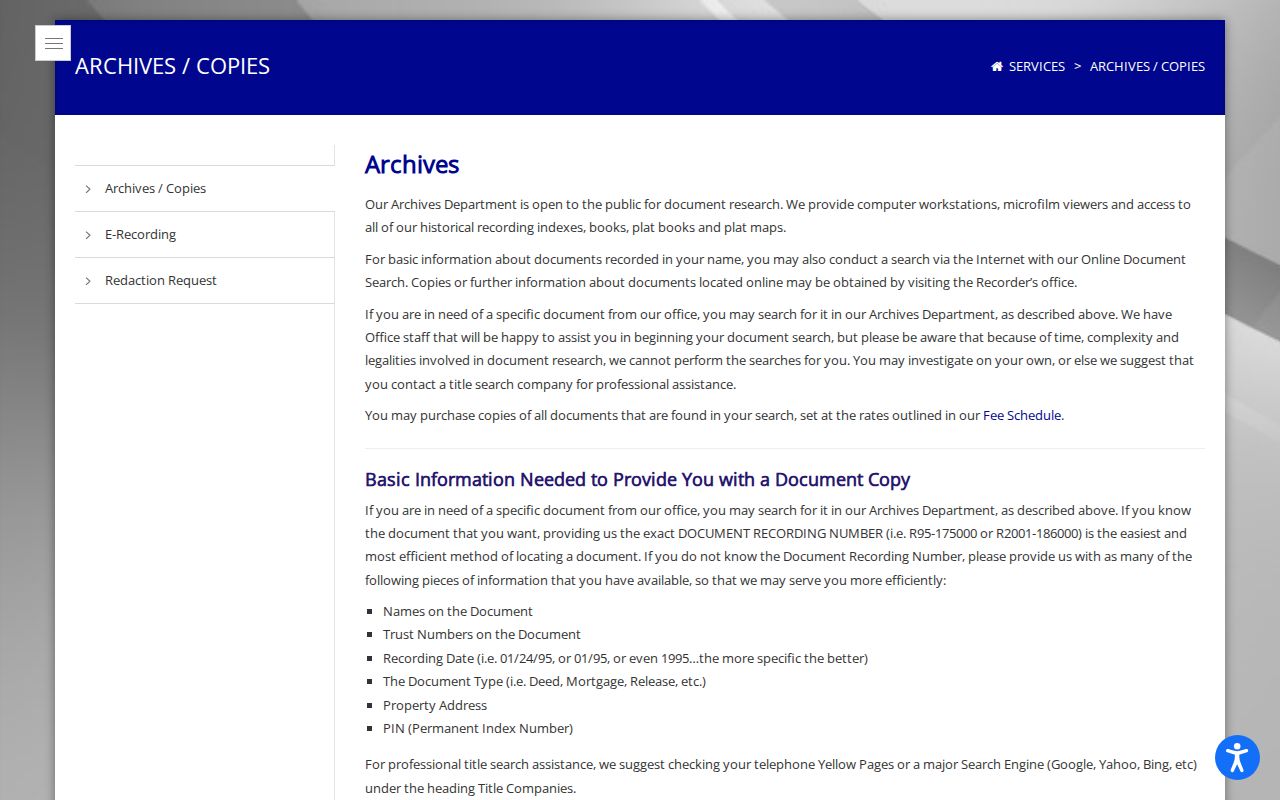
Bring the accumulated deed numbers and names so the archive search begins with exact, testable leads.
Homer Glen's 2001 Record Pivot
Homer Glen incorporated on April 17, 2001. Before that date, a house may appear under Homer Township, a rural route, nearby city wording, or county administration rather than the village name. After incorporation, village ordinances, permits, maps, annexation files, and agendas add a municipal layer. County property and deed custody remains central across both periods.
The distinction changes where to ask. Older road and township context can be in IRAD series, including Homer Township road papers from 1837 to 1878, a road record from 1850 to 1909, and township proceedings from 1854 to 1947. Village-era questions can move through the Clerk, Building Department, Document Center, and Illinois FOIA. This 2001 split is one of the clearest ways to keep a Homer Glen previous residents search in the correct archive.
Note: Municipal incorporation changes record custody and labels, but it does not reset the county deed chain for the land.
Homer Glen Address Changes
Many Homer Glen addresses moved from the historic 60441 postal label to 60491 during the 2003 to 2004 transition. Some areas retained Orland Park, Mokena, or Lemont postal labels. Recorder address search also omits the street suffix, so a search for 151st may need a second try as 151. Rural routes, abbreviated road forms, subdivision names, and township labels can all mask the same physical place.
Run the old and current forms in parallel. Compare the parcel's legal description, subdivision, lot, block, old book/page, and deed references. A parcel split can assign a new PIN, so do not assume today's number follows the land forever. USPS confirms the present postal line, while assessment, GIS, and deeds establish the physical and legal geography.
Pair Homer Glen Directory Years
A title chain names recorded owners. To learn who lived here before, place dated directory and phonebook entries beside public census schedules. Joliet Public Library's regional holdings include Will County directories for 1859 to 1860 and 1872 to 1873, Joliet directories from 1875, and telephone directories from 1908. Plainfield material includes regional directories and phonebooks. Coverage of the future Homer Glen area can be indirect, so each result needs its printed geography.
- Choose a deed transfer or known event and search the closest directory year before it.
- Search the first available directory year after it under every period postal city and road form.
- Compare the surname, address, phone, and any household notation without treating an omission as proof of a move.
- At a released census year, locate the township or enumeration area and compare the full household and nearby names.
- Use newspapers, probate, cemetery material, and the next deed to test the resulting timeline.
The regional collection details belong to the Homer Glen city directory collections. Here, each volume serves only as a dated point in one address history.
Homer Glen House History Help
No official Homer Glen house-history guide was located. The practical research desk is the Joliet Public Library Local History Room. It holds directories, telephone books, newspapers on microfilm from 1846 forward, atlases, plat books, obituary indexes, yearbooks, and archival material. A Local History Librarian appointment is needed. Staff can search newspaper microfilm for an obituary, birth notice, or marriage notice when given a month and year.
The Will County Historical Museum collections and research service adds photographs, architectural surveys, mortgages, court and church records, newspapers, and genealogy material. Ask about scope and fees for a place-based request.
The museum's research page shows the collection route available when previous residents appear in local papers, images, or property files rather than a web index.
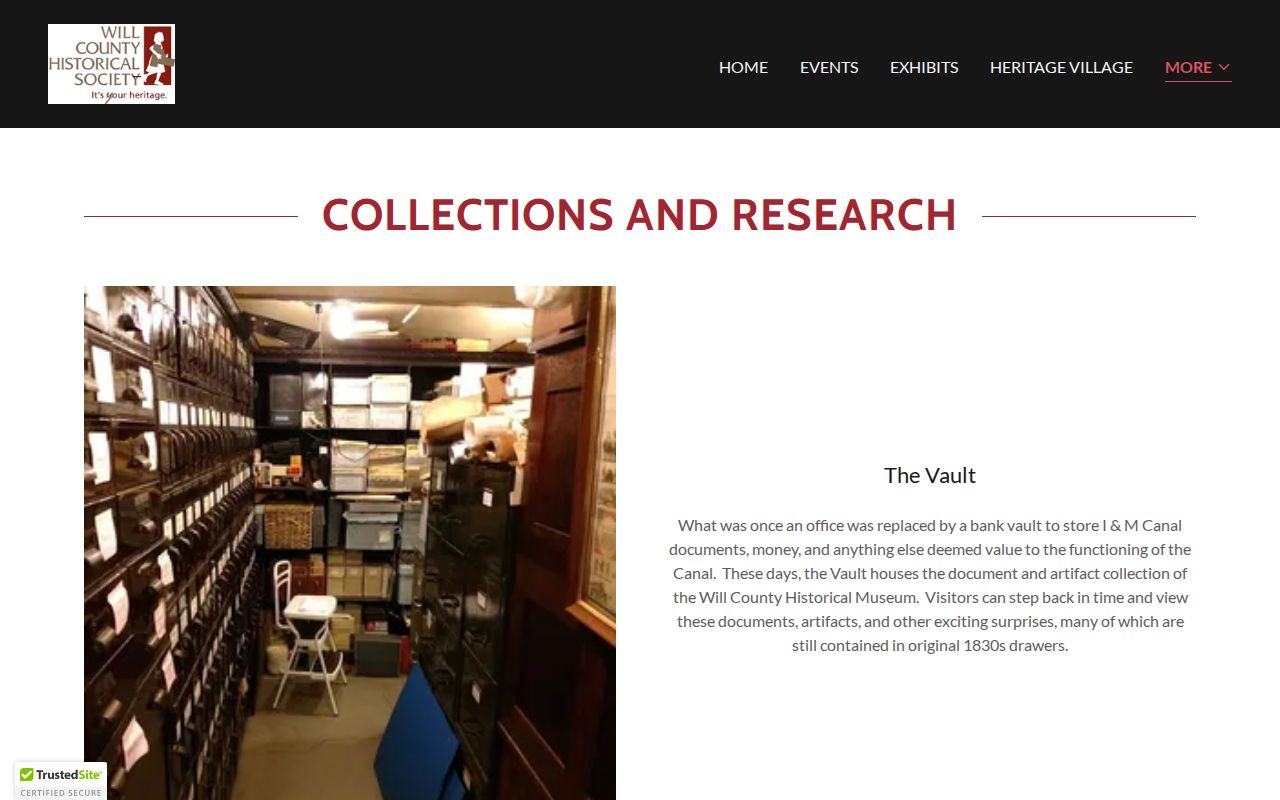
A concise request should name the place, date span, known owners, street variants, and the evidence already checked.
Map the Homer Glen Property
Maps and permits date the site, not its occupants. Plainfield's repository lists an 1873 county atlas and digital Sanborn maps for various years. Library of Congress metadata identifies Joliet Sanborn maps from 1886, 1891, and 1898. No official Homer Glen-specific Sanborn sheet was located, which fits the area's rural and township setting at the time. Use those regional maps only when their sheet geography truly includes the target place.
Village permit and inspection records may show a site address, issue date, work description, valuation, applicant, contractor, inspections, plats, certificates, or violations if retained and public. Ask the Building Department or Village Clerk, and use a focused FOIA request when no public index exists. A permit can explain when a structure changed, but the name on it is not a list of past residents.
Close a Homer Glen Household Trail
Obituaries, cemetery books, probate files, death indexes, and a final deed can mark the end of an owner's or occupant's connection to an address. Joliet Library holds obituary indexes for 1915 to 1918 and 1976 to 2012, plus funeral brochures for African Americans of Joliet and Lockport from 1968 to 2012. IRAD Will County series include probate records from 1837 to 1905, with other court and vital series covering specific years.
Match names, kin, dates, and place references cautiously. An heir named in probate is not automatically a resident or title holder. An obituary may report a former home rather than the place of death. The most useful endpoint is a dated cluster: the last directory entry, obituary or probate evidence, and the deed that transferred the land.
Note: Keep owner, occupant, heir, mailing recipient, and business roles in separate columns so one record does not blur them.
Limits on Homer Glen Past Residents
Previous residents are rarely captured by one complete public source. Regional directories can omit a rural road or an unlisted phone. Census schedules are released after a long delay. The assessment owner may receive tax mail elsewhere, and a trust or estate can interrupt the personal name chain. A deed proves a recorded interest, not who slept in the house. State and county privacy limits also restrict vital, voter, protected-address, sealed, and sensitive information. Those limits belong in every search for previous residents.
Build the result as a dated evidence table. Save the source URL, retrieval date, exact PIN, legal description, deed number, record date, image status, and uncertainty. When an online search fails, use the Recorder counter and microfilm, library staff, museum research service, IRAD, the Village Clerk, or the office that holds the record.
Lawful use. Research Homer Glen past residents for family history, house history, estate questions, or personal curiosity. Never use the findings to harass, pressure, or track a living person.